The Nigerian Academy of Science, NAS, has said that it is vigorously addressing the problem of predatory academic practices which is common in tertiary institutions and research institutes globally and is now becoming a major problem in Nigeria.
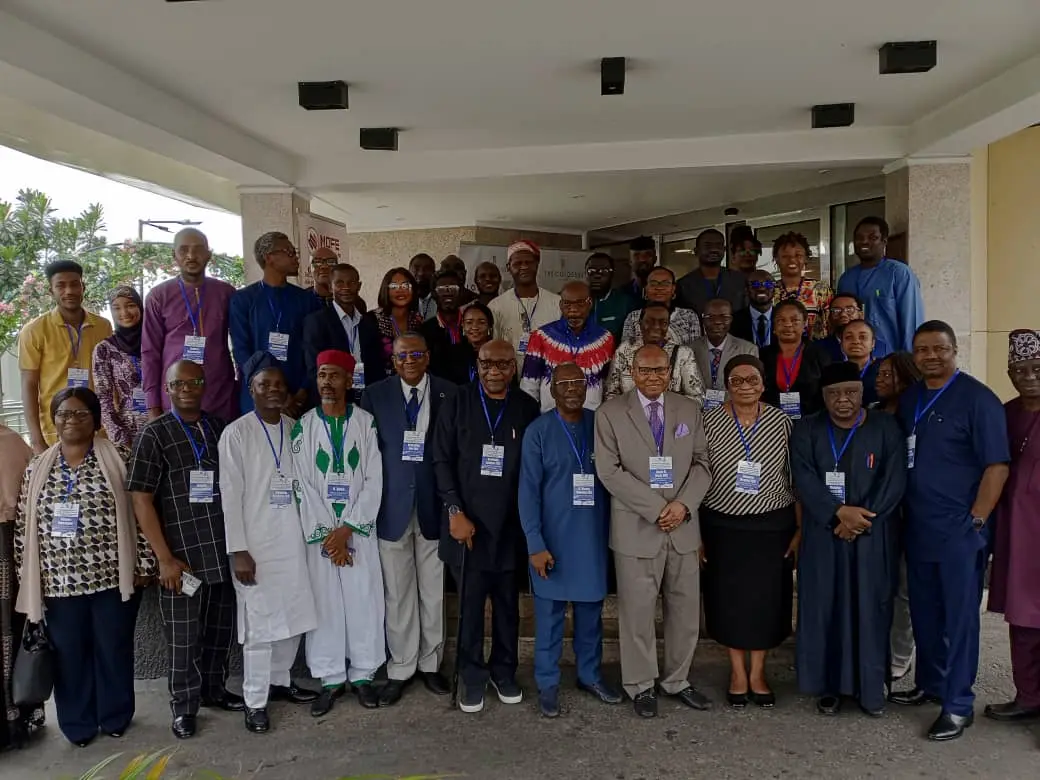
The president of NAS, Professor Ekanem Braide FAS, disclosed this at the Research Mentorship Programme Wrap-up Workshop with the theme, “The Strengthening Research Capacity in Nigeria Project”, saying the initiative was aimed at enhancing scientific research capacity in Nigeria, as well as facilitating an enabling environment for research and researchers to thrive in Nigeria.
According to her, the mentorship programme was in line with NAS’ mandate of assisting government and other stakeholders in solving national problems that could be addressed through application of science, technology and innovation. Adding that, one of such problems is poor research translation that is bridging the gap between knowledge gained through research and its application in policy and practice.
She explained that fellows of the Nigerian Academy of Science are determined to trigger a change in this narrative by encouraging collaboration between researchers, industry and government (where political will resides) in a triple helix arrangement, to cause this change to happen.
“The Nigerian Academy of Science has held a number of webinars and workshops to raise awareness on predatory academic practices and their detrimental effects on Nigerians.
“The Academy is also implementing other activities to address the problem. Predatory academic practices definitely compromise the integrity of research.
“The Nigerian Academy of Science is also intervening in education at the sub-national levels. We are aware that with the existence of many codes, laws, decrees, roadmaps, and policies, from colonial era, through to independence up until now, Nigeria is faced with what could best be described as an emergency in the education sector.
“One cannot treat each level of education in isolation because products from the lower-level flow into the higher level. Even below the lowest level we still have the problem of out of school children which every stakeholder should address.
The quality of the final output of tertiary education depends on the quality of input at secondary and primary schools because inadequacies in each level affect the next level.
“The Nigerian Academy of Science, the Nigerian Academy of Letters and the Nigerian Young Academy, with support from the Joint Admission and Matriculation Board (JAMB), have embarked on a project aimed at strengthening Science, Technology, Engineering, Art, and Mathematics education in primary and secondary schools.
“The aim is to promote a well- rounded and comprehensive education that encompasses a wide range of disciplines through training the trainers, infusing life-building skills in curricula, utilizing indigenous knowledge systems, and enhancing skills in science and technology.
“Fortunately, we have succeeded in advocating for partnership in the Federal Ministry of Education, Universal Basic Education Commission (UBEC), National Universities Commission and All Nigeria Conference of Principals of Secondary Schools (ANCOPS).
Lamenting that facilities such as laboratories, libraries among others are absent in most public schools. There are also not enough adequately trained teachers to stimulate interest of pupils and students in science.
“Expectedly, many youths from public schools who gain admission into science programmes in tertiary institutions lack basic science foundation for a successful career in science.
“This has far- reaching negative effects on learning and eventually on quality of research output’, she said.
However, Braide noted that, “For research outcome to be useful the quality must be high and for quality to be high there must be proper mentorship beyond thesis supervision.
“Apart from strengthening research capacity, adequate mentorship will also result in redirection of research to address existing problems in Nigeria.
“We urged all stakeholders to partner with us on this and other projects aimed at bringing education back on tract in Nigeria”, she said .
Also, the Executive Secretary, NAS, Dr. Doyin Odugbanjo, said that the programme was to identify the fact the country is losing many senior researchers who are retiring while many of the young ones are leaving the country and the ones that are not leaving have fewer opportunities due to lack of senior colleagues who could not show them the way.
“There is a gap and in a few years, the professors that we would be having would not have enough experience hence the need for a mentee-mentor project to breach the gap. We paired 20 mentees who are early researchers and 20 mentors who are senior researchers and who are also fellows of the Academy of Science.
“They were mentored for five months and the aim was to set the mentees in the right direction. It was also to modify some of the goals to sharpen them as well as show them other opportunities that they do not know. It is to advise, encourage, and inspire them to move on despite the challenges that are stirring them in their faces.
“In five months, I believe lots have been achieved and we have had all positive feedback. The mentors and the mentees are excited as many of them are already reporting their career impacting results.
“They are publishing papers, journals, finishing up their PHD thesis which they were getting tired of. Some have gained entrances to fellowships, associations that they did not know about.
“The mentees were selected from different areas of science and they applied to the academy of science and we selected them based on their performances and excellence”, he said.
One of the mentors, Prof. Andrew Verla, Imo State University, said that, “His experience was exciting and rewarding. Within five months that I was engaged by NAS to mentor Dr. Wahab, I have seen tremendous development in him in terms of generating ideas and making sure that the research idea is put into work.
“I have seen him develop confidence as a researcher and I was glad when he told me that when the next NAS’ mentee-mentor programme is organised, he will signify to be a mentor.
“We have developed lots of things. We have written a book on green chemistry, we have had about two publications and we have two researches which we have applied for grants and we believe that through NAS, we will get it.
“We are going to attract grants into Imo State University. This is the first time such a thing is organized in Nigeria and I wish that the government of Nigeria will be able to support NAS”, he said.
One of the mentees, Haleematu Bindir, PhD student of African University of Science and Technology, Abuja, said, “I joined this mentee-mentor programme in May and partnered with Dr. Sanni, from Covenant University.
“For five months, the experience has been enlightening and I found lots of things to learn from my Mentor. He was enthusiastic and that encouraged the enthusiasm in me and together, we worked very hard.
“I have learnt about the fundamentals of research in my PhD project. We worked on improving my writing and right now, I have manuscripts written which I did not have before starting the programme. We have plans to continue and produce more.
“Research is extremely important in terms of pushing any nation forward. I have been fortunate to hear stories from other countries that have risen from lower levels of poverty to an imaging economy, especially South Korea in a relatively short space of time and that through their drive to incorporate science into the economy and building knowledge.
“Through those models, they have developed their countries and I think it is really important for research activities to be institutionalised as a recurring practice and embedded within us because that is what will lift this country. Without knowledge, there is nothing anyone can do and research is about gathering knowledge”, she said.