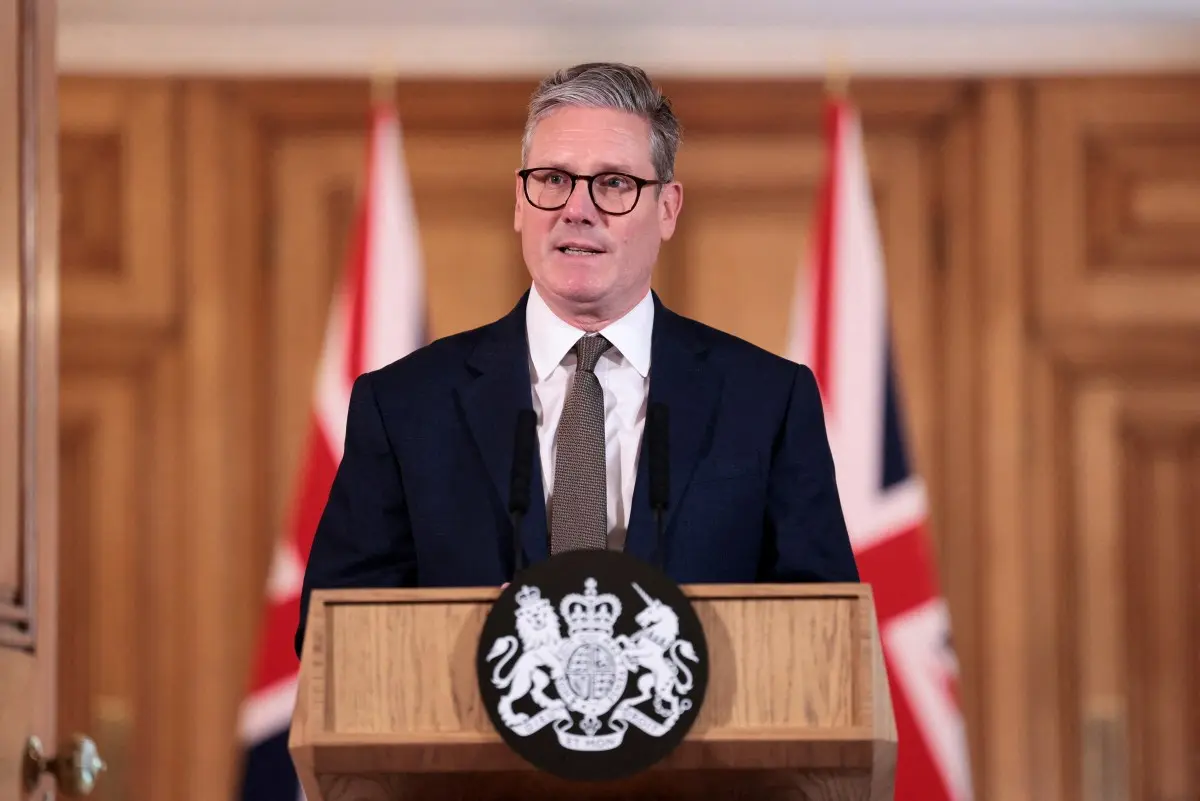
Keir Starmer is preparing to face his initial grilling in the House of Commons as the Prime Minister of the United Kingdom this Wednesday. This significant event follows his recent decision to suspend seven members of his own Labour Party who defied the party line regarding a highly controversial welfare policy.
The suspension of these Labour MPs took place late Tuesday evening, a move that has drawn considerable attention, especially since the MPs had expressed their support for a motion advocating the abolition of the contentious two-child limit on benefits. This limit, which was put in place by the previous Conservative government, has been a focal point of debate and disagreement among lawmakers.
The vote by the Labour MPs to endorse the motion to eliminate this cap is particularly noteworthy as it represents an early and significant test of Starmer’s authority as party leader. The two-child limit, initially introduced in 2015, significantly restricts financial assistance, as it only allocates benefits for the first two children born to most families, leaving many in precarious situations.
In the face of such challenges, Starmer, the new leader of the UK, has been vocal about the complexities surrounding child poverty, declaring that there is “no silver bullet” when it comes to eradicating this pressing issue. Nonetheless, he did acknowledge and appreciate the fervor exhibited by those MPs who are ardently opposed to maintaining the existing policy, indicating he understands the emotional stakes involved in this debate.
Starmer’s decision to suspend the whip from this particular group of left-leaning MPs, which notably included former finance spokesman John McDonnell, can be interpreted as a demonstration of his firm approach to leadership. This move is being seen as an assertion of his control and a clear signal to the party that dissent will not be tolerated lightly.
Starmer has only recently taken over the leadership of the Labour Party, stepping into this pivotal role just weeks ago after his party triumphed in a general election held on July 4, thus ending a long 14-year stretch in opposition since 2010. This victory is the culmination of a four-year effort on Starmer’s part to guide Labour back towards the political center, a significant shift away from the hard-left ideology propagated by the former leader, Jeremy Corbyn, whose leadership saw the party suffer its worst electoral result in nearly a century during the 2019 elections.
Today, Starmer will be present in the Commons at 1100 GMT for his inaugural weekly session of Prime Minister’s Questions, where the heated topic of the two-child cap is likely to emerge as a critical point of discussion among MPs.
Just late Tuesday, Members of Parliament voted decisively, with a count of 363 to 103, to dismiss an amendment put forth by the Scottish National Party (SNP) that sought to repeal the cap. This outcome effectively provided the government with a substantial majority of 260 votes. However, it is noteworthy that in addition to the seven Labour MPs who chose to support the amendment, more than 40 Labour lawmakers abstained from voting altogether. This abstention highlights the deep-seated unease and division that exists within the center-left party regarding this welfare measure.
In the midst of this political tension, Liverpool MP Kim Johnson publicly stated that she had cast her vote alongside the government “for unity.” However, she emphasized that the intense feelings within her party on this issue are “undeniable.” This indicates a significant level of concern among party members about the implications of the two-child policy on the communities they represent.
The SNP’s Westminster leader, Stephen Flynn, did not hold back in criticizing Labour’s handling of the situation, claiming the party had “failed its first major test in government” by opting not to implement “meaningful change from years of Tory misrule.” His comments underscore a growing frustration from opposition parties as they observe Labour’s approach to this contentious welfare issue.
“This is now the Labour government’s two-child cap,” Flynn asserted, adding that Labour must fully acknowledge the consequences of this policy, which contributes to the worrying levels of poverty that persist across the UK. His remarks encapsulate the ongoing struggle within UK politics to address the welfare state’s effectiveness and its impact on vulnerable populations amidst a backdrop of rising discontent.