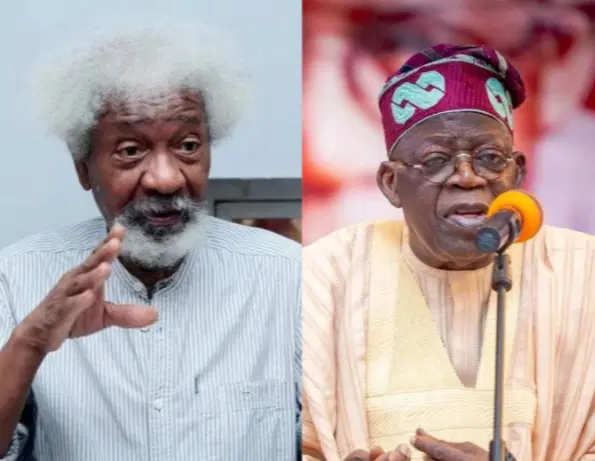
Nobel laureate, Prof. Wole Soyinka, expressed his deep dissatisfaction on Sunday regarding President Bola Tinubu’s national broadcast, specifically highlighting the glaring omission of any discussion related to the violent crackdown by security forces on protesters participating in the #EndBadGovernance movement. The absence of such a crucial topic in the president’s address raises significant concerns about the approach taken by the government towards peaceful demonstrations and civic engagement.
In a statement reflecting his views, Soyinka articulated his disappointment over the president’s neglect of this critical issue. He stated, “I set my alarm clock early this morning to ensure that I did not miss President Bola Tinubu’s impatiently awaited address to the nation concerning the ongoing unrest sweeping across the country. As a committed citizen, I thought it imperative to be attentive to what the leader of our nation would say about these pressing issues.”
Soyinka noted that the president’s outline of the government’s remedial actions since his administration’s inception, which were intended to mitigate such unrest, will undoubtedly be subjected to expert scrutiny and sustained attention in terms of both effectiveness and content analysis. However, he asserted that his primary focus remains on the alarming and continuing deterioration of the state’s handling of protests—a crucial area where the presidential address fell remarkably short, failing to adequately address the realities faced by citizens on the ground.
He emphasized that this neglect is a disservice to civic engagement, which regrettably empowers security forces to act with impunity. This not only entraps the nation in a seemingly never-ending cycle of resentment and retaliatory violence but also signifies a significant regression in the relationship between the state and its citizens. Soyinka pointed out that the use of live ammunition as a response from the state to civic protests is the core issue at hand. He further highlighted that even the deployment of tear gas is questionable in most scenarios and constitutes an abuse in situations where protests are clearly peaceful and non-threatening.
Soyinka elaborated on the nature of hunger marches, asserting that they represent a universal call for action—a cry for help that transcends the borders of Nigeria. These marches belong to a distinct class of their own, despite the various collateral claims that may adorn protest posters. They serve as a summons to governance, signaling that a breaking point has indeed been reached among the populace. Such marches offer a vital opportunity for the government to recognize public desperation and take heed of the people’s needs.
The tragic and inappropriate response to the ongoing hunger marches in different parts of Nigeria, coupled with the timely warnings issued prior to such protests, demonstrates a worrisome regression that takes the nation even further backward than the severe fallout experienced during the watershed ENDSARS protests. This current situation invokes memories of colonial disdain and oppression, reminiscent of pre-independence actions that profoundly affected the Nigerian populace, inspiring the late stage pioneer Hubert Ogunde’s folk opera, BREAD AND BULLETS, a work that ultimately faced nationalist persecution and prohibition by the colonial authorities.
Soyinka pointed out that Nigeria’s security agencies cannot feign ignorance of alternative models for civil engagement and security. He posed the rhetorical question of whether we truly need to be reminded of the recent nationwide editions of what is commonly referred to as the YELLOW VEST movement in France during 2022 and 2023. He suggested that observing such scenarios should become a fundamental part of the curriculum for police training. Throughout his observations of the protests in France, Soyinka noted that he did not witness even a single instance of firearms being aimed at protesters, let alone discharged during direct confrontations.
The application of bullets in response to citizens merely pleading for basic sustenance is a disturbing regression, and history shows that such actions often serve as a precursor to far more desperate upheavals, revolutions, and widespread societal unrest. There comes a time when society must recognize the need to abandon, once and for all, the outdated and regressive reliance on lethal force employed by security agencies in the governance of the nation. No country is so underdeveloped, materially impoverished, or inherently insecure that it lacks the will to set a positive example through non-violent means.
All it requires is a commitment to recall the nation’s own historical struggles and exercise the necessary will to initiate a meaningful transformation, creating a break in the unfortunate chain of lethal responses directed at civic society. Soyinka urged today’s marchers to consider incorporating the key songs from Hubert Ogunde’s BREAD AND BULLETS into their demonstrations, if only to instill a sense of collective shame concerning the persistent failure to rise above the lingering shadows of colonial inheritance. It is critical for society to understand that one way or another, this vicious cycle of violence and oppression must ultimately be broken for the good of the nation and its citizens.