ABUJA — Comrade Festus Osifo, the President of the Petroleum and Natural Gas Senior Staff Association of Nigeria, commonly known as PENGASSAN, attributed the ongoing issue of persistent fuel queues seen in various locations across the country primarily to a fundamentally weak distribution chain within the downstream sector of the oil and gas industry. Osifo made this assertion on Thursday during the second day of the 3rd edition of the PENGASSAN Energy and Labour Summit held in the capital city of Abuja. During his address, he urged the need for immediate and decisive reforms to address these pressing issues facing the industry and to improve the overall fuel distribution process in Nigeria.
Osifo elaborated that Nigeria’s current distribution chain, which heavily relies on the use of trucks to move fuel across the nation’s extensive geography, is not only outdated but also grossly insufficient to meet the increasing demands of the country’s large and growing population. He pointed out the inefficiency of such a model, emphasizing, “There is no country in the world as large as Nigeria, with our population size, that depends on a singular point for product importation while utilizing trucks to transport goods to every nook and cranny of the nation.”
As the PENGASSAN president and leader of the Trade Union Congress (TUC), Osifo explained that the existing distribution method is highly susceptible to various disruptions, which can lead to significant reductions in fuel availability, particularly as a result of poor road conditions and flooding during the rainy season, both of which can severely hamper transportation efforts and contribute to widespread fuel scarcity across the country. Osifo strongly emphasized the critical necessity for the government to invest in the development and strengthening of Nigeria’s energy value chain to achieve a more efficient and dependable distribution system. He issued a clear warning that unless these critical improvements are made, Nigeria will continue to experience ongoing and recurring fuel shortages that impact the nation’s economy and daily life.
In addition to addressing the distribution chain challenges, Osifo also raised several other vital issues currently plaguing the oil and gas industry. He pointed out that the high production costs faced by companies operating in Nigeria are approximately 15 to 20 percent higher than those in other regions around the world. This disparity, he noted, is partly the result of the considerable security burdens that oil and gas companies must bear while trying to operate within the country. He passionately called on the government to assume greater responsibility for security, indicating that doing so could substantially decrease the overall production costs and create a more favorable business environment.
Furthermore, Osifo urged the government to take more stringent measures to strengthen laws and penalties against individuals involved in oil theft, advocating for harsher consequences that would serve to discourage unethical practices and promote higher standards of integrity within the oil and gas sector. He commented on the pressing need for a robust framework to combat oil theft, which undermines the industry and contributes to economic inefficiencies.
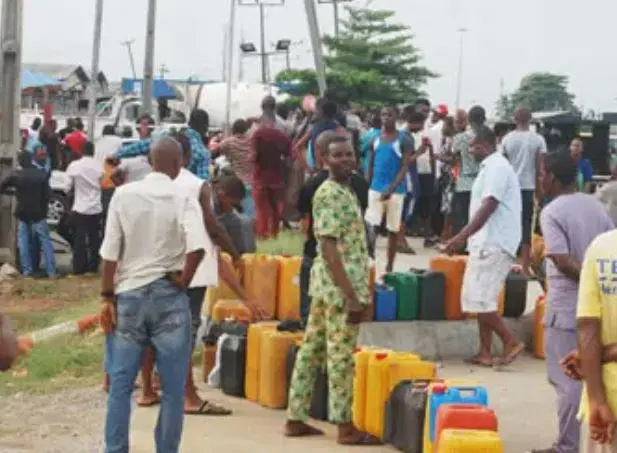
The PENGASSAN President reiterated that the challenges plaguing the distribution chain are serious, highlighting that the weakness of this distribution chain in the downstream segment of the oil and gas industry is at the heart of the current fuel queue crises. He stated, “This is exactly why we see long queues at most fuel stations today. The underlying problems may be addressed temporarily, but they are bound to resurface again tomorrow if the foundational issues remain unresolved.”
Osifo further explained, “There is no nation in the world quite like Nigeria, with a population as vast as ours, that relies on importing fuel to a central point and then using trucks for distribution. Whenever difficulties arise, such as when roads become impassable or flooding occurs, those trucks encounter significant challenges that prevent them from transporting fuel as needed. Consequently, this leads directly to fuel scarcity.”
He concluded by stressing, “We must undertake every possible action to bolster and revitalize this critical sector of our fuel distribution system. As PENGASSAN, we have brought this matter to the forefront before, and we continue to emphasize today that it is imperative to develop and enhance the entire value chain within the oil and gas industry.”