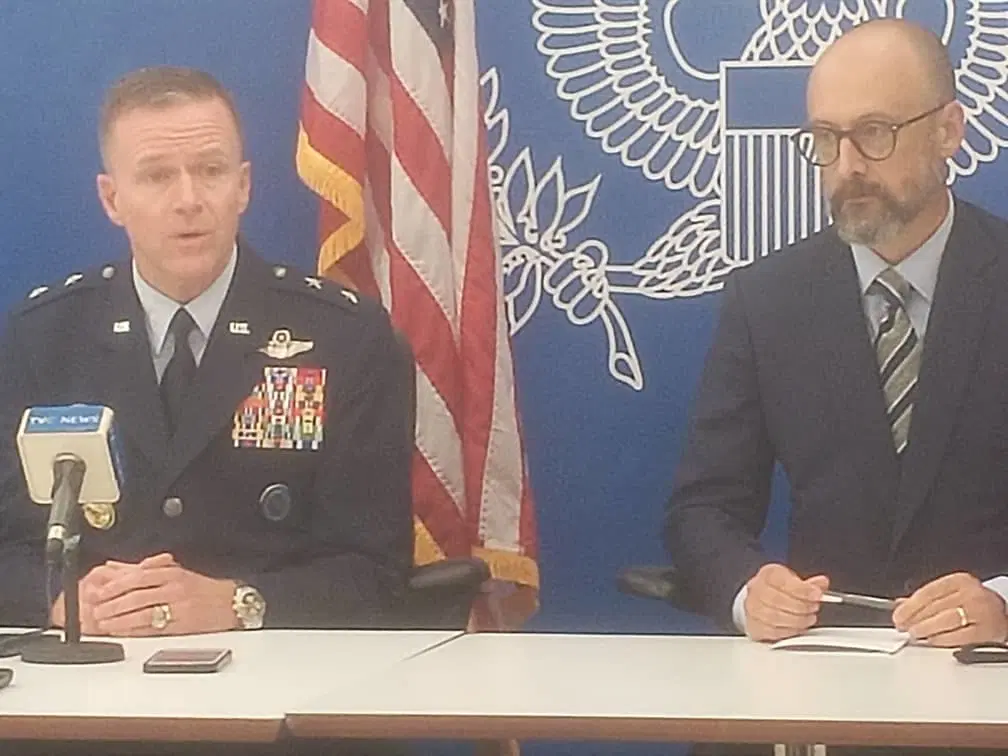
The United States government has firmly stated that there are currently no intentions to establish a U.S. military base in Nigeria, especially in light of the recent withdrawal of American troops from the Niger Republic. This assertion was made clear by Major General Kenneth Eckman, who serves as the Element Lead for Coordination at the U.S. Africa Command, which is part of the Department of Defense focused on West Africa. During a briefing held in Abuja on Friday, he emphasized, “There are no plans for a U.S. base here in Nigeria. I understand that this is a significant concern for many. The presence of U.S. forces indeed carries both costs and benefits, which can vary depending on the specific context, but I want to provide reassurance that there are no plans for such a base.”
When asked about the purpose of his visit to Nigeria, General Eckman, who is responsible for coordinating efforts with African militaries and allies to enhance security across the continent, clarified, “I am not aware of any discussions between U.S. and Nigerian officials regarding the establishment of a U.S. base in Nigeria as a result of the withdrawal from Niger. I want to be absolutely clear on this point. However, the pressing issue we are addressing is the rise of violent extremism originating from the Sahel region. With the U.S. no longer operating in Niger, it raises the question of where our focus should shift next.”
He elaborated on the strategic approach, stating, “This situation has led us to adopt an outside-in strategy concerning the Sahel region. When we consider this approach, it is crucial to ask what role Nigeria will play, given its strength as a nation and the close partnership we share. This is a very natural question to raise, and I can understand why some individuals might assume that discussions were taking place regarding this matter.”
General Eckman further explained the military strategies in the region, saying, “As military strategists, we often discuss key terrain. At present, the critical terrain related to the threats posed by ISIS-Sahel and the Jama’a Nusrat ul-Islam wa al-Muslimin (JNIM) lies within the tri-border area that encompasses the western part of Niger and extends into Burkina Faso. This region is of paramount importance, and our Burkinabe partners can attest to that. However, it is worth noting that this partnership has diminished recently.”
In response to the evolving security landscape, he stated, “Consequently, we are enhancing our collaboration with Côte d’Ivoire, Ghana, and other allies, focusing on increased training and joint operations.”
Providing an update on the withdrawal of American troops from Niger, General Eckman shared, “I have just returned from Niamey, where I have been since early April. My primary responsibility has been to oversee the complete withdrawal of U.S. forces from Niger. We are nearing the conclusion of this process. Together with our Nigerien partners, we have successfully achieved a safe, orderly, and responsible withdrawal of U.S. forces.”
He continued, “On August 5th, we witnessed the final C-17 aircraft depart from Air Base 201, located in Agadez, marking the last significant movement of U.S. personnel and equipment. Just two days ago, we finalized the handover of the last U.S. location. As I speak to you now, all remaining non-tactical and non-technical U.S. facilities, areas, and materials in Niger have been transferred to the Nigerien military and authorities. Therefore, we are very close to completing this withdrawal.”
General Eckman attributed the smooth execution of this withdrawal process to the close cooperation with Nigerien officials, stating, “The manner in which this withdrawal unfolded, and the reason I am able to report on it before the September 15 deadline, is due to the strong coordination with our Nigerien partners. It was a shared objective for both parties to ensure that the withdrawal proceeded as seamlessly as possible, and I am extremely grateful for their collaboration. The positive news is that the withdrawal has gone well.”
However, he did not shy away from addressing the negative aspects of the situation, noting, “The unfortunate reality is that regional security is facing significant challenges. Therefore, in parallel with coordinating the withdrawal, we have also been actively engaging with our regional military partners to address the increasing threat posed by violent extremist organizations that have emerged from the Sahel region.”
In discussing the broader implications of these developments, General Eckman reflected, “While our goals remain unchanged—goals that we share with our African partners—achieving them has become increasingly difficult. As I travel throughout the West African region and engage with both civilian and military leaders, there is a shared concern about the risks involved. If there is one consensus among us, it is the recognition of these risks.”
He emphasized the importance of collaboration, stating, “Our approach has been to engage with our regional military partners and their civilian leadership, starting with active listening. Each context, geographic area, and military partner presents unique needs and varying strategies for tackling regional security challenges. Therefore, our process begins with understanding these differences. The United States, through U.S. AFRICOM, operates in West Africa by working closely with our partners. We do not act independently; rather, we conduct operations that are partner-led and U.S.-enabled.”
General Eckman elaborated on the nature of U.S. support, saying, “We do not execute operations on behalf of our partners; instead, we empower them to carry out their operations more effectively. This collaborative effort is built upon a solid foundation of security cooperation, which encompasses exercises, training, and grant/security assistance. These elements are crucial to establishing a robust security partnership, while the operational activities we conduct represent only a small fraction of our overall engagement.”
When asked about the impact of violent extremism on Nigeria from the perspective of AFRICOM, General Eckman responded, “We perceive the threats and risks in a very similar manner. Nigeria is fortunate to possess a strong military and effective policing institutions. Our discussions have centered around the solutions that Nigerian authorities are pursuing and how U.S. security assistance plays a role in enhancing those efforts.”
He concluded by stating, “I believe our perspectives align closely, and the reality is that with the departure of U.S. forces from Niger, the overall security situation in the region has deteriorated. However, I want to highlight that in certain instances, regional partners have effectively collaborated on security initiatives. For example, two weeks ago, I visited Ndjamena, where the Multinational Joint Task Force (MNJTF) operates within the Lake Chad Basin. This organization, which is led by a member of the Nigerian military, is, in my opinion, performing commendably in addressing security challenges in the Lake Chad Basin area.”
Addressing the question of whether a military approach can effectively resolve issues of insecurity, particularly regarding terrorism and violent extremism, General Eckman stated, “What AFRICOM is pursuing is a broader strategy, recognizing that merely countering terrorists militarily addresses only the symptoms of a much deeper issue. The real challenge lies in tackling the underlying causes and foundational factors that contribute to the existence and perpet