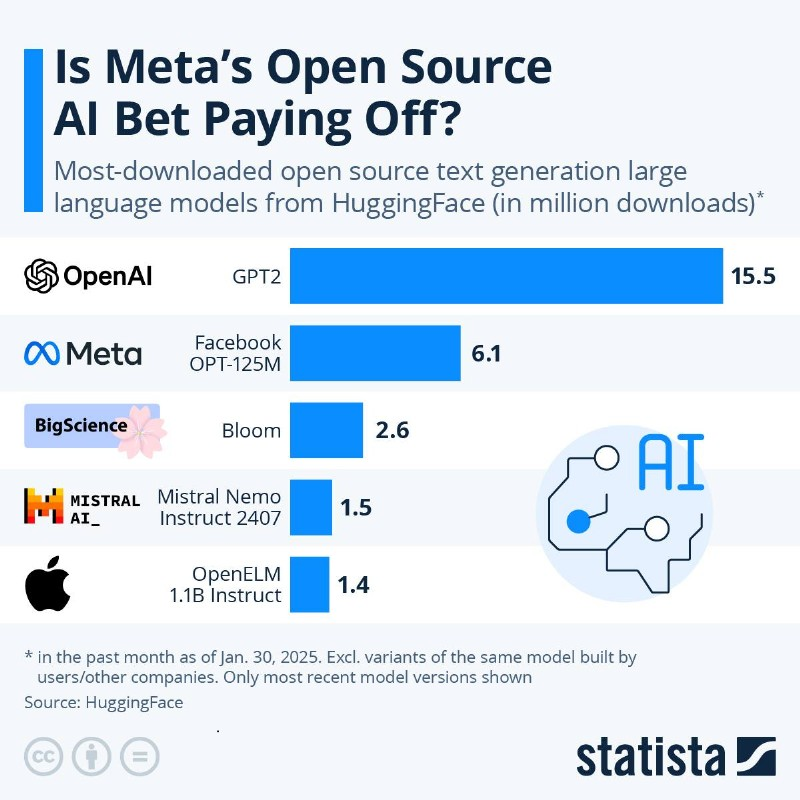
Evolving world of artificial intelligence, Meta’s ambitious bet on open-source AI models has yet to dethrone OpenAI’s established dominance. Despite Meta’s significant investments and efforts to promote open AI ecosystems, new data from Hugging Face reveals that OpenAI’s models continue to lead the pack in popularity and usage. This raises questions about whether Meta’s open-source approach can eventually tip the scales or if proprietary AI will remain the industry standard.
### OpenAI’s GPT-2 Still Reigns Supreme
According to the latest statistics, OpenAI’s GPT-2 remains the most downloaded AI model, boasting an impressive 15.5 million downloads. This figure more than doubles the downloads of Meta’s top-performing model, Facebook OPT-125M, which has garnered 6.1 million downloads. The stark contrast highlights the enduring demand for OpenAI’s technology, even as newer models from competitors enter the market.
While OpenAI’s GPT-2 was released several years ago, its continued popularity underscores the strength of the company’s early innovations in the AI space. OpenAI’s ability to maintain a strong foothold in the industry, despite the emergence of open-source alternatives, speaks to the effectiveness of its proprietary approach.
### Meta’s Open-Source Push Faces Challenges
Meta has been a vocal advocate for open-source AI, positioning its models as accessible and collaborative alternatives to proprietary systems. However, the data suggests that the demand for Meta’s open-source offerings, such as Facebook OPT-125M, still lags behind OpenAI’s older models. This gap indicates that while open-source AI has its merits, it has yet to achieve the same level of widespread adoption or recognition as OpenAI’s proprietary solutions.
Meta’s Llama models, which are part of its broader strategy to compete in the AI space, have shown promise but have not yet managed to close the gap with OpenAI. The company’s commitment to open-source principles is commendable, but it faces an uphill battle in convincing developers and enterprises to switch from established proprietary models to its open alternatives.
### Other Competitors in the Race
Beyond Meta and OpenAI, other players are also vying for a share of the AI market. BigScience’s Bloom, with 2.6 million downloads, Mistral’s Nemo at 1.5 million, and even Apple’s OpenELM, which has garnered 1.4 million downloads, are all part of the competitive landscape. While these models trail behind both OpenAI and Meta, their presence demonstrates the growing diversity of AI solutions available to developers and researchers.
### The Future of AI: Open-Source vs. Proprietary
The ongoing competition between Meta’s open-source models and OpenAI’s proprietary systems raises important questions about the future of AI development. Will Meta’s Llama models eventually gain enough traction to challenge OpenAI’s dominance, or will proprietary AI continue to reign supreme? The answer may depend on several factors, including the quality of the models, the ease of integration, and the level of support provided by the respective companies.
For now, OpenAI’s GPT-2 remains the benchmark for AI models, with its massive download count reflecting its widespread utility and trust among users. Meta’s open-source approach, while innovative and aligned with the ethos of collaboration, still has ground to cover in terms of adoption and performance.
As the AI landscape continues to evolve, the competition between open-source and proprietary models will likely intensify. Whether Meta can eventually tip the scales in favor of open-source AI remains to be seen, but one thing is clear: the race to dominate the AI industry is far from over.