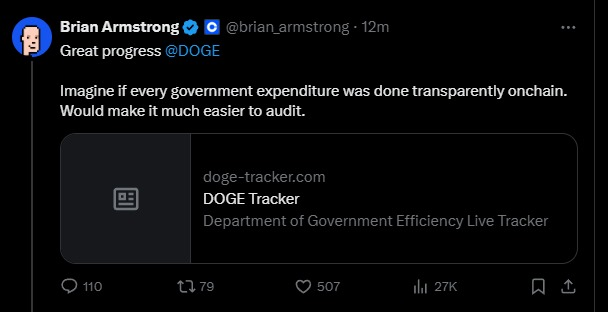
Coinbase CEO Brian Armstrong has proposed that all government spending be recorded on the blockchain. This revolutionary idea aims to transform budgets into open, immutable ledgers, ensuring that every tax dollar is traceable, every transaction is visible, and corruption is eradicated.
Armstrong took to social media to share his thoughts, stating, “Great progress @DOGE. Imagine if every government expenditure was done transparently onchain. Would make it much easier to audit.” His comments highlight the potential of blockchain technology to bring unprecedented transparency and accountability to public spending.
A New Era of Financial Transparency
The concept of putting government spending on the blockchain is rooted in the technology’s core strengths: decentralization, immutability, and transparency. By recording expenditures on a public ledger, every transaction would be permanently logged and accessible to anyone. This would eliminate the opacity that often shrouds government budgets and create a system where citizens can track exactly how their tax dollars are being used.
Armstrong’s proposal comes at a time when trust in government institutions is waning in many parts of the world. Scandals involving misappropriation of funds, hidden deals, and lack of accountability have eroded public confidence. Blockchain technology could serve as a powerful tool to rebuild that trust by ensuring that every financial decision is open to scrutiny.
The Benefits of Blockchain for Government Spending
1. **Enhanced Accountability**: With every transaction recorded on the blockchain, government officials would be held to a higher standard of accountability. Any misuse of funds or suspicious activity would be immediately detectable by auditors and the public.
2. **Reduced Corruption**: The immutable nature of blockchain would make it nearly impossible to alter records or hide transactions. This would significantly reduce opportunities for corruption and fraud.
3. **Improved Efficiency**: Blockchain could streamline the auditing process, making it faster and more cost-effective. Real-time tracking of expenditures would allow for quicker identification of inefficiencies or errors.
4. **Increased Public Trust**: By providing citizens with a clear view of how their money is being spent, governments could foster greater trust and engagement. Transparency could also encourage more informed public discourse on budgetary priorities.
Challenges and Considerations
While the idea of blockchain-based government spending is compelling, it is not without challenges. Implementing such a system would require significant technological infrastructure and a willingness from governments to embrace radical transparency. Privacy concerns would also need to be addressed, as some transactions may involve sensitive information.
Additionally, the transition to blockchain would require widespread education and training for government employees and the public. Ensuring that all stakeholders understand how to use and interpret blockchain data would be critical to the system’s success.
A Call to Action
Brian Armstrong’s vision is a call to action for governments worldwide to explore the potential of blockchain technology. By adopting transparent, onchain systems, they could set a new standard for accountability and integrity in public finance. As blockchain continues to evolve, its applications in governance could revolutionize how societies manage and monitor their resources.
The future of government spending may very well be on the blockchain—a future where hidden receipts are a thing of the past, and every dollar is accounted for. Armstrong’s proposal is a reminder that technology has the power to transform not just industries, but the very foundations of how we govern.